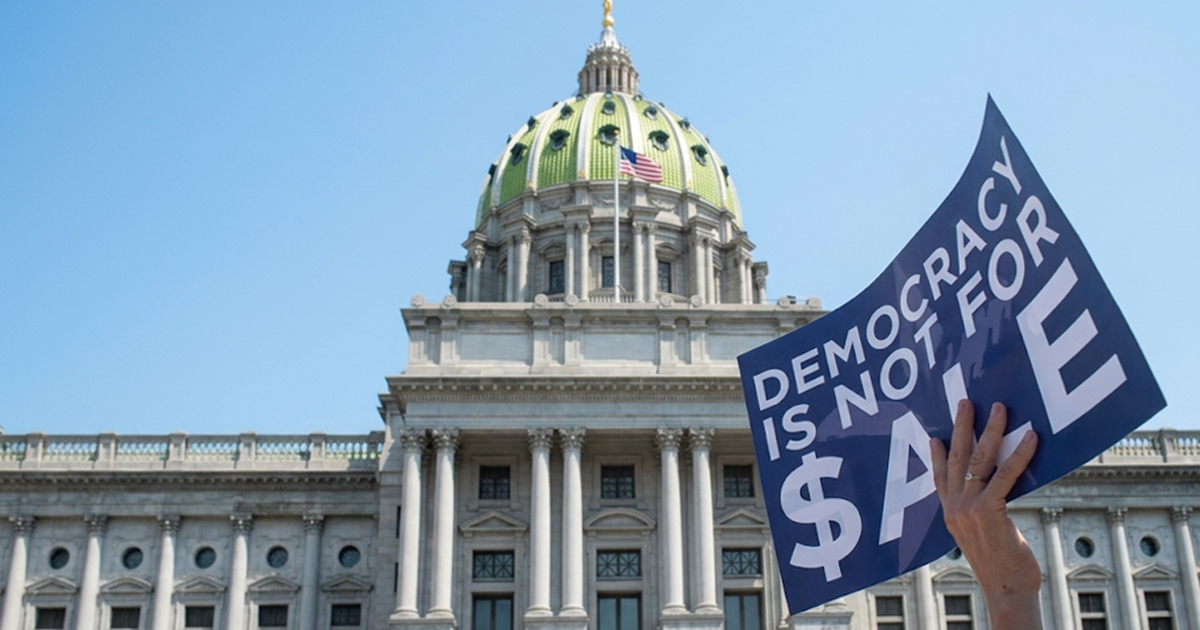
DELAWARE COUNTY, PA – September 9, 2026 – Senator Tim Kearney (D-26) announced new legislation to stem the avalanche of corporate money flooding Pennsylvania elections. The proposal, Democracy is Not for Sale: Stopping Corporate Super PAC Influence in Elections, uses the Commonwealth’s authority over corporate charters to restrict corporate political spending and restore the connection between voters and their elected officials.
“Americans of every political stripe are disgusted by the influence of money in our elections,” Senator Kearney said. “Corporate super PACs and corporate-funded dark-money groups have overwhelmed the voices of real voters, and Pennsylvania has the authority — and responsibility — to act.”
Concerns about corporate influence and declining trust in government are widespread; according to Gallup, nearly 90 percent of Americans believe corruption is pervasive in the federal government, a perception that has grown alongside rising corporate political spending.
The legislation rewrites the general powers of Pennsylvania corporations, nonprofit corporations, and LLCs to exclude the power to make donations or contributions to election or ballot-question activity. Because corporations are creations of state law, not innate holders of constitutional rights, Pennsylvania can define and limit the powers it grants corporations, a principle the U.S. Supreme Court has repeatedly affirmed in its decisions that corporations possess only the powers states choose to confer.
Corporations formed outside the Commonwealth but operating here would face the same restrictions in Pennsylvania’s elections.
“One of our top priorities is responsibility and accountability, we want elected officials to answer to voters, not corporations. When corporate money is used to influence elections, it erodes the connection between voters and their elected officials,” said State Rep. Joe Webster, sponsor of companion legislation in the House.
“There are no disclosure requirements, and these corporations often have vast amounts of resources that allow them to shout louder than any group of voters,” Webster added. “It’s time we address the issue of outsized influence in our elections and get Pennsylvania voters and their interests back at the forefront of our work in Harrisburg.”
Pennsylvania’s corporate statutes have not kept pace with the rapid expansion of corporate political spending. This legislation establishes a clear boundary: corporations may not use state-granted powers to influence elections in the Commonwealth. The proposal also outlines an enforcement structure through the Department of State, ensuring that violations carry real consequences for corporations — whether formed in Pennsylvania or operating here from elsewhere.
This legislation has also been introduced in the Pennsylvania House as HB 2728 by Reps. Joe Webster (D-150), Paul Friel (D-26), Tarik Khan (D-194), and Ben Waxman (D-182).
Momentum for this charter-based approach is growing. Hawaii enacted similar corporate restrictions earlier this year, and Montana voters will consider a statewide ballot measure this November to prohibit corporate political spending.
“Pennsylvanians are sick of corporate and dark money in politics,” Senator Kearney added. “By refining the powers we grant corporations, we can restore trust, strengthen fairness, and make clear that democracy is not for sale.”
Senate Sponsorship memo: https://www.palegis.us/senate/co-sponsorship/memo?memoID=49217
###